Translate Caskstrength!

Showing posts with label Bill lark. Show all posts

Thursday, 6 March 2014

Streuth! A Quick Chat With Casey Overeem, Founder of the Old Hobart Distillery


'I'll never forget meeting my uncle in Norway many years ago now', says Casey Overeem, with a smile on his face.  

'When I arrived at his house, he said (in his somewhat broken English) 'Casey...you... me... friends'... and we went down into his cellar - and there in a cupboard, dripping away, was a little still.  After a few minutes we had a glass worth each and he said Skal! Well, I thought he meant 'Skull' (meaning 'down in one') which probably wasn't the greatest thing to do with spirit straight off the still at 70%.' 


This was the first experience of distilling for the highly affable and down-to-earth Overeem and clearly, the brutal, high strength spirit he had just knocked back must have made its mark in more ways than one. Today, The Old Hobart distillery which Overeem founded back in 2005 is steadily securing a reputation around the world for arguably producing Tasmania's best whisky, with new fans discovering the small but exquisite range mostly on the recommendation of those in-the-know or from the growing number of glowing reviews. We can put our hands up and say that we are keen supporters of the work Casey and his team are doing, first trying the range of four whiskies last year purely by chance.
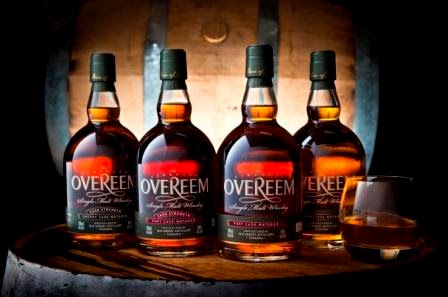


To say we were impressed would be an understatement. We caught up with Casey on a recent visit to London to discuss the ethos behind the distillery and what he believes is the secret behind the burgeoning whisky scene in Tasmania. 


First up though, we're keen to find out what made Casey continue with his fascination into distilling after such a highly spirited introduction.

'Well I wasn't a whisky aficionado or anything like that. It was really down to my experience in Norway,' he explains. 'I said to Greta, (Casey's wife) i've gotta build one of those stills when we get back home. I basically got a beer vat and started brewing using sugar as the base - like a rum.  Well, that didn't taste much good at all, so we really started doing some proper research about cut points and then over the next five years we learnt to make whisky.' 

Back then, it was a case of Casey sticking his finger in the glass and setting it on fire to determine the stage of the spirit run, but now, after running Old Hobart for around a decade, everything seems to have settled into its right place. 

'Now we don't really have any specific technique to determine cut points etc, it's all done by nose as the runs are so consistent,' he points out. Our stills are made by a guy in Hobart called Peter Bailey- he does everything from copper shaping to welding, boiler making and still design,' he continues, 'which is why I guess distilling has taken off so well in Tasmania. We have two stills: a wash and a spirit, with electric heating elements underneath, which makes them very clean inside. We tried to emulate what would have happened when they were direct fired from underneath. When I was in Scotland, I took a load of pictures of different stills, mainly for the lyne arms, particularly the ones which gave a heavier, more oily new make spirit which is what I was looking for. I think you'll find ours bears a certain resemblance to a popular one on Islay', he says grinning... 'They're such a special bunch of distillers there - and we owe them a lot of gratitude as they were very helpful when we were setting up the distillery.'


So how many casks do you fill now? 

'We fill about one barrel a week now- maybe 60 in the course of a year, all into 100 litre first-fill casks. 

'So a very small outturn then?

'For sure. Funnily enough, a mate of ours was visiting Islay recently and mentioned to a distiller that he had a friend who owned a distillery back home. The distiller asked how many casks we were filling and laughed when our mate told him."We probably spill more than that a year", was his response!'

'How did you determine what sort of wood you wanted to use?'

'Well Bill Lark (owner of the Lark distillery and one of the founding fathers of the resurgence in Australian whisky making) and I went to Scotland in 2005 and one of the head distillers on a tour said that if they could afford it they would mature everything in 100 litre barrels, so Bill took that on board and I followed suit. Nearly everything we fill into is from cut down ex-Australian port or sherry casks from French oak - filled at 63.5% - but the Angels' Share is extremely high here. In five years we've probably lost about 20% of the spirit. We'll usually get about 180 bottles (at 43% strength) from each cask and although each barrel is consistent, there will be subtle differences in each bottling, but we're hugely proud of each one.' 

Have you tried maturing in anything bigger?

'We did try a 200 litre and it was very good indeed, (a mythical bourbon barrel bottling, which we have yet to try) but anything smaller takes a lot of colour but doesn't give us the quality of flavour we are looking for. Interestingly, I think the whisky is really peaking around five years -  the oldest cask I have is about six-and-a-half years old and i'm not convinced it's getting better. But there's a significant change in the last few months of maturation: the difference between the whisky at four-and-a-half to five years is profound.' 

Have you tried using any refill casks? 

'I reckon i've got about 25 or 30 refill barrels that i've filled - some port and some sherry- but i'll have to wait longer, probably 7-8 years to get what i'm looking for from them. But I really don't want to change the recipe of what we do, as we don't make enough to do many risky experiments with.'

Would you say you've learned a number of different lessons as a distiller over the years?

'Two things spring to mind. Firstly, making the whisky is the easy part!  But secondly, getting everything else right - ie getting people to put your whisky on the shelves and then into the hands of drinkers is another thing. It's taken a long time for Tasmanian whisky to become accepted and to be early in an emerging scene is a challenge, but it's also good as we're finding people are likely to take a real chance on you.'

So is there a good camaraderie between the other Tasmanian distilleries?'

Very strong indeed. We share ideas and we promote the idea of Tasmanian whisky together in bars and wherever we can, as well as meeting often and sharing a dram together. It's like a piece of rope: single strands have no strength, but put many of them together and you have some real pulling power.'

What makes Tasmania such a great place to make whisky?

'The climate is ideal really - we have a bigger temperature range than Scotland- good dry air which creates some movement through the barrels, some exceptional soft water and we grow some of the best barley in the Franklin variety- it's a strain which is now on its way out, but was sought out the world over for brewing beer. And of course passionate people!'

Jane Overeem, carrying on Casey's
knack for making Tasmanian whisky
So where do you see it going, over the next decade?

'Well I did this as a hobby originally!' he laughs. 'My daughter Jane has been pressing me for an answer like that too. She's an integral part of what we have done and ten years later, here we are. You only have one life and this has certainly been the most exciting part of mine and the most high profile.'

As we wrap up our interview at the Southbank Centre on the River Thames, with a backdrop of London at its finest, it dawns on us that it must make Casey feel proud that his whisky has literally come such a long way.

'It's totally humbling when you consider the origins of where it all started,' he points out. 'In fact, if you look at the cap on the bottle, you'll see it says three words: Born Of Promise.  I made a promise to myself when I started that I wanted to get a bottle on the shelves in Holland, where my father was born and the very first international order we had was from a shop in Holland - Van Wees. What was remarkable is that it turns out the shop was only 10km from where he grew up and was in the town he did his apprenticeship! 

Fate moves in strange ways...

To read our review of the current range of Overeem whiskies distilled at the Old Hobart distillery, click here


For more info on the distillery itself, visit: www.overeem.co.uk


Tuesday, 6 August 2013

Ho Ho Hobart...Overeem Australian Whisky


Continuing our theme of interesting world whiskies you probably haven't heard of this month, we bring you news of a brace of new Aussie whiskies about to hit these shores, from The Old Hobart Distillery in Tasmania.  Australian whisky making has really begun to attract the sort of feverish attention it deserves thanks to a number of recent award successes and better distribution outside of Australia and the Old Hobart Distillery located to the south of Tasmania, is the latest to capitalise on this interest.  

Casey and Jane Overeem
The story begins back in 2005 when Casey Overeem, owner and head distiller was granted a distillers licence, with production beginning in earnest in 2007.  The small batch operation was producing around 5000 bottles of whisky a year, mostly matured in a mixture of cut down 100 litre quarter cask port and sherry casks and today the distillery is now running at a capacity of 8000 bottles a year.  


It's a remarkable testament to the explosion of craft distillation in Australia, which can really be traced back to Bill Lark, owner of the Lark Distillery, who first helped change Australian legislation concerning the minimum size of stills allowed in the production of craft spirits.  Since the landmark date in 1992, when Lark was established, Tasmania now boasts at least nine working distilleries (making whisky) with another couple in the planning stages -  heady times indeed.  

So what of the whisky itself?  Well, we've been sent four different expressions: two matured in sherry casks and two matured in port influenced French oak casks.  The differing strengths (two at 60% and two at 43%)  will give us a rough idea of where this spirit is heading. We're told that the casks selected here are between five and seven years old and judging by Casey Overeem's steady hand on the tiller, he's selecting what works best and when.  

Overeem Single Malt Whisky -  Old Hobart Distillery -  Sherry Cask Matured - 43%

Nose: Immediately, this is very inviting and open, with notes of spiced apple pie, vanilla ice cream some perfumed notes and a slight vegetative note (boiled sweet potato.) Given time some sweet, plump raisins come to the fore, alongside a little dustiness and some cracked black pepper. Extremely rich and complex, all said and done.  

Palate: Wonderfully spicy and sweet, with star anise, clove and cinnamon dusted apples coating the palate, alongside some dried fruits (apricot and date), soft caramel and some vibrant blood orange notes.  Balanced and very impressive indeed for a youthful whisky. 

Finish: Lingering notes of dark chocolate, orange zest and toasted malt give this a luxurious and very lengthy finish.

Overall:  What a flying start.  Make no mistake, this is high quality whisky making and what's clear is the care and attention that has gone into pulling this expression together.  Highly recommended if you're a fan of big, bold sherry monsters. 


Overeem Single Malt Whisky -  Old Hobart Distillery -  Sherry Cask Matured - 60%

Nose: Wallop.  This is a big hitter.  Wonderful wafts of classic sherry wood hit first, with juicy raisins, dates and prunes, coupled with woody spices, stewed Bramley apple and perhaps just a faint whiff of some smoky embers from a long forgotten fire.  With water (just a touch, mind) the lighter fruits come through with more precision, alongside a creamy vanilla.  

Palate: At 60%, this is clearly going to be a powerful experience, but extremely pleasing nonetheless. Bold sherry notes (oloroso and PX sweetness) sit alongside a sharp burnt orange zest note, some menthol tones, a blast of anise and high quality cocoa enriched chocolate.  With a dash of water, the fires are tempered slightly, but none of the resonance is lost: a touch of woody smoke can be found if you look hard enough, alongside some toasted nuts, celery hearts, flat cola syrup and vanilla. Superb stuff. 

Finish: Lengthy, with drying notes of moist raisins and orange peel.

Overall: Consider us mightily impressed, Mr Overeem. At this stage of the distillery's production I doubt many people would have expected what has been achieved here, which all points to further greatness in the future.  

With the sherry expressions working far beyond our expectations, let's delve into the port expressions...


Overeem Single Malt Whisky -  Old Hobart Distillery -  Port Cask Matured - 43%

Nose: Distinctly more perfumed than its tempestuous sherried sibling, this is calmer, more restrained and less bombastic.  It has a delicate balance of white flowers, vanilla, ripe summer fruits (strawberry, plum, nectarine and redcurrant) with a sweetened cream drizzled over the top.  Dig a little deeper and some polished wood begins to emerge with some tinned peaches popping in for good measure, but not enough to trouble the fresh and fruity frisson that works so well.  About as summery a whisky as you could hope for. 

Palate: The sweetness of the first sip gives way to notes of liquorice, lemon grass, some toasted oak and a darker, richer fruitiness, one can only assume is derived from a ruby port:  think blackcurrant, toasted vanilla, dark chocolate, a touch of spice and notes of leather and lemon zest.  

Finish: Subtle and balanced, with a few drying notes of tannic oak and cigar leaf. 

Overall: A start contrast to the sherry matured expressions, but no less exciting. This is a superb example of getting the balance between spirit and wood character absolutely spot on.  

Finally, the more shouty port expression... could this be a clean sweep?


Overeem Single Malt Whisky -  Old Hobart Distillery -  Port Cask Matured - 60%

Nose: A very different aroma meets the nose than from the lower ABV version. This time around, it's cracked hard caramel, a touch of butterscotch sauce, roasted walnuts and freshly turned earth, alongside wafts of fresh pine smoke.  The lighter fragranced notes are probably in there, waiting to be set free from the spirit, but this is an altogether more grown up affair.  

Palate: The higher strength brings an explosion of bold flavours:  a distinct toasted nuttiness, some bitter dark chocolate, a touch of espresso coffee, liquorice root, flambeed orange peel and creme brûlée topping.  Think after dinner complexity, from that of an XO Cognac or Armagnac and you're in the same ballpark.  With water, the perfume notes and a lighter orchard fruit note balance with the bolder flavours from above and you're left with something altogether exceptional.  

Finish: Lingering notes of liquorice, orange zest and toasted chocolate malt.  

Overall: What can we say... four outstanding whiskies from this fledgling distillery. With the growth in craft distillation, it would be easy to say that anyone with enough time, financial backing and vision could turn in a drinkable whisky, but to get to this level of finesse in such a short space of time is very unique and requires something extra, unobtainable by conventional means.  It's clear to us that Casey Overeem has a bag full of this fairy dust at his disposal and we very much look forward to trying the next whiskies he decides to give a sprinkling to.

Follow Overeem on Twitter:  @OvereemWhisky